A handbook for starting and running a Community Science Workshop
3. A CSW’s Contents and Layout
4. CSW “Curriculum”: Projects, Activities, Exhiblets, Specimens
5. CSW Programs
6. Leadership, Operation and Development of the CSW Organization
CSWs serve kids and families with a wide range of programs. Programs can be viewed as the means by which we take our precious content to kids and families. We can talk philosophy and pedagogy all day long, but it’s in the programs that the CSW rubber hits the road. Our philosophy is the thread with which we patch the fabric of our programs into the quilt of a CSW.
Each CSW has a different set of programs baked into their pie, determined by various factors including staff interest, funding possibilities, community demand, age of students to be served, space and facility options, and available time. Some CSWs have only two or three program types in operation, while others engage in most of these over the course of a year.
In this section, the 14 current program types will be described followed by a brief analysis. Note that some CSW programs are familiar STEM/STEAM programs (though these are done with a distinct CSW twist), while other CSW programs are unique, in that it is rare to find them offered by anyone else.
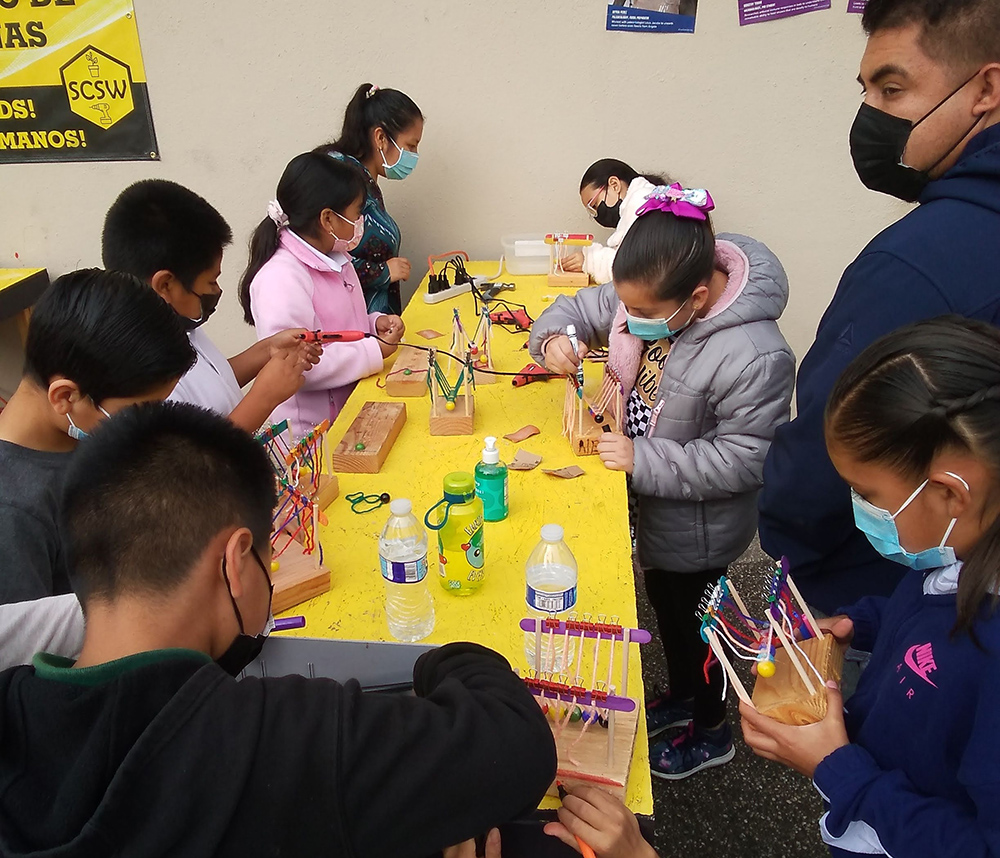
This is the foundational program of the CSWs. It is guided by participants themselves with an enormous range of possibilities available, low structure, and free. It is facilitated by caring adults who know how to make good experiences happen for kids both in science and engineering as well as in the socio-cultural realm. Close to paradise, it is our educational paragon; a space where creative tinkering dreams come true and imaginations are turbo-charged. It is the public face of the CSW as community resource, to be used according to community wishes. CSWs strive to have some drop-in hours each week.
With this program groups like YMCA, scouts, or school-based afterschool groups come to the CSW, usually on a regular basis. Curriculum is open to broad possibilities.
This program can be a large part of a CSWs operations, and bring in a good part of the funding. Class visits are typically aligned with the school’s curriculum, and sometimes the teachers are able to make topic requests. If classes come several times per year students can get quite a deep experience at the CSW from this program alone.
CSW staff can go to schools and serve one or more after-school groups. The CSW activity sometimes becomes the most popular one in the whole after-school lineup.
CSW Mobile Units can be taken to schools, parks, libraries, or community centers during out-of-school time to serve local kids and families, usually on a drop-in basis. This includes mobile workshops (full set of tools and materials) as well as Physics Bus arrangements (mostly exhiblets and a few high-interest activities).
CSW Mobile Units can be brought to schools, parked on the field or playground, and opened for many classes to rotate through during the course of the school day.
Usually offered at schools with other CSW programs going on, CSW staff can offer programming during the lunch period after kids have eaten.
CSW staff can visit a classroom to do a set project or activity, or bring special exhiblets or specimens.
CSWs can organize transportation to a local or distant natural site to learn directly from the living world. Overnight camping and backpacking are also done by some CSWs.
This can include family science nights, street parties, Day of the Child, Earth Day, etc. Often several projects, activities, exhiblets, and specimens are prepared and presented at the event, and if the CSW has a Mobile Unit, it may be open for use as well. Sometimes extra prep is done for the projects to make sure participants with only a little time can have success, and often shorter, easier projects are presented.
This may include a whale or other skeleton, giant blood vessel, etc. San Francisco CSW has developed this program to a stratospheric level: a special van takes their baby grey whale skeleton to a school where class after class of kids can take it apart and put it together like the 40 foot puzzle it is. Their walk-through blood vessel is set up in a school’s library or multi-purpose room and every fifth grade class gets to see all the larger-than-life pieces of this critical element of the vertebrate body. This kind of program can also be done with less fanfare, such as bringing snakes or an electrostatic generator to a school.
These can be related to community interests with a link to science such as health, environmental conservation, and astronomical events. CSW staff can lead a local group of kids and adults to gather data and learn more about the issue at hand. Professional scientists may be involved.
If teachers or after-school facilitators need support amping up the hands-on aspect of their curriculum, CSWs can help.
Many CSWs have been asked to package projects and activities in kits (including videos and writeups) for teachers or facilitators to use in another setting.
CSW programs can be considered from various dimensions:
Time Window. During the school day; or during out-of-school time.
Activity Structure. Participants can do the project or activity of their choice and pursue it to the extent that they choose; or there is a set activity that everyone will do (almost always with some creative choice options, but no option to work on something completely different).
Attendance. Participants drop in on their own volition and stay as long as they please, or they are enrolled in some sort of program or group in which they are not free to come and go, and must remain at the Workshop for the set time period, or until they are picked up.
Rich Mulch. Access to it; or limited access. Here the term mulch refers to the exceptional CSW variety of fascinating and stimulating tools, materials, exhiblets, specimens, take-apart junk, and project models. When programs can be run at a CSW space or with the support of a mobile unit containing a significant amount of this mulch, the experience of the participants is far superior to situations when the program must be run in, say, a classroom, and all that can be brought in must fit on a little cart.
Possibility for Ongoing Contact. Yes; or difficult. Some programs are of a one-and-done variety: special presentations at schools, family nights, or street fairs. Participants may not come from the local community, and even if they do, CSW staff may not know them, and may not see them again. Other programs allow long-term relationships to build between participants and staff, and between participants and the CSW. Sometimes one-off programs can be used to draw participants into other programs where they will become long-term regulars. For example, at a school’s family science night, kids and parents can be informed about drop-in CSW hours and teachers can be informed about school-day CSW opportunities.
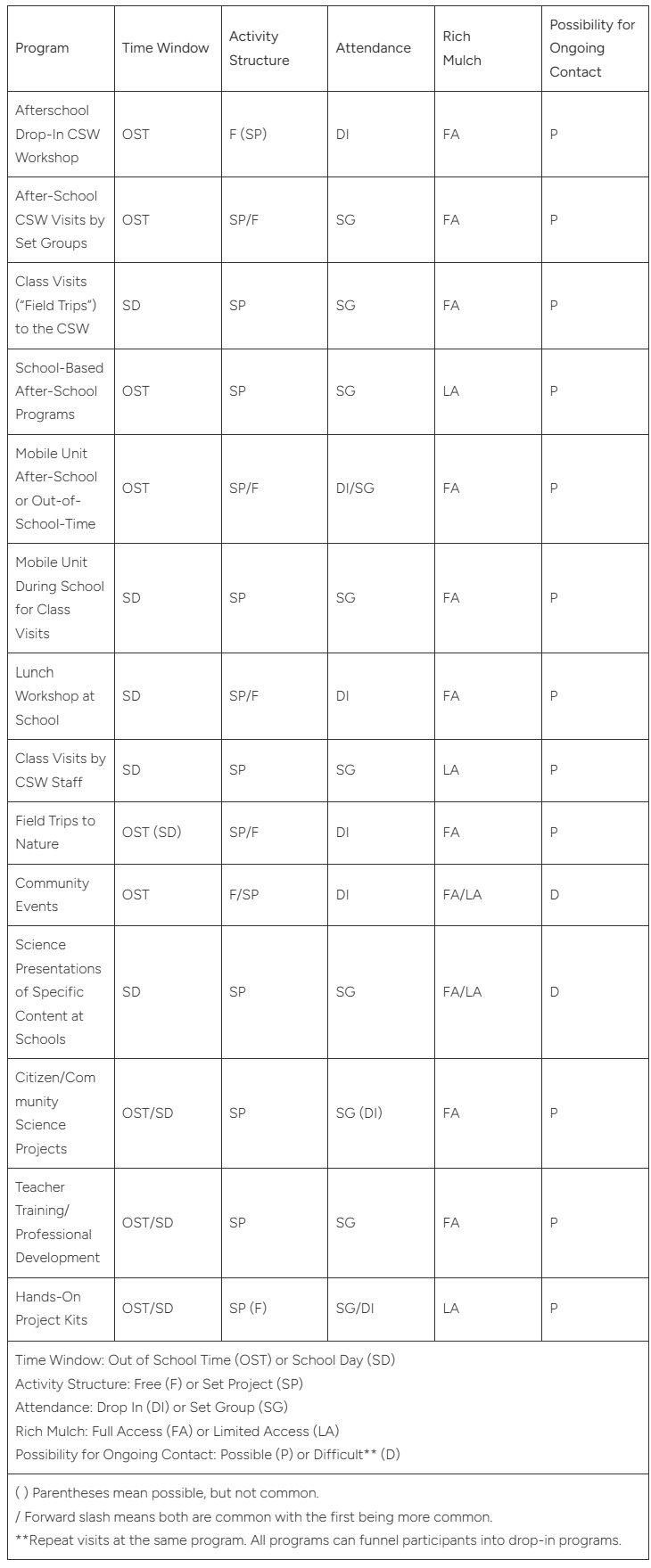
To simplify and get a better overview, each of these dimensions may be placed into a binary framework (“either/or”) with abbreviation.
| Dimension | Either | Or |
| Time Window | Out of school time (OST) | School day (SD) |
| Activity Structure | Free (F) | Set project (SP) |
| Attendance | Drop in (DI) | Set group (SG) |
| Rich Mulch | Full access (FA) | Limited Access (LA) |
| Possibility for ongoing contact | Possible (P) | Difficult** (D) |
** It’s always possible to invite participants in other programs to come to the open-door drop-in program.
A table of the 14 programs categorized by these dimensions is included below, and a full google spreadsheet of the programs sorted by the five dimensions is here.
As noted, some of the programs are rare and unique, and some are common STEM/STEAM programs. The flagship program of CSWs is the open-door, open-structure program, otherwise known as drop-in, free-for-all hours, or simply “Open Workshop.” This program is foundational to our history and philosophy, and binds the other CSW programs together:
We pride ourselves in this program and believe it offers something essential to both individuals and to a community. We recognize that some kids and families will be unable to attend it, but still make an effort to open this program to as many as possible.
Along with drop-in being the model that best captures our philosophy, drop-in is also the one that is unique in the STEM/STEAM world. You can drop-in at a bar, a hardware store, a library, a barber, a parts shop, a playground, a beach, a hiking trail, a climbing wall, but only at a CSW can you drop in and make a jewelry box for your mom.
As with any drop-in program, attendance may vary wildly. Sometimes the space is packed and kids are having trouble finding space to work, seeping out the door and into the hall, and staff are barely sufficient to keep chaos at bay. Sometimes the space is empty with a kid or two fiddling with some uninspiring tidbit. When numbers are down, it is time to think about outreach, to make sure everyone in the target community is aware of the wonders awaiting them at the CSW. When numbers are up, it is time to look around and note what you’re doing right. In the end, the attendance at a drop-in program is only partially under the influence of our actions; much is left to fate.
Some of us have a strategy of dealing with slow days that involves working on other projects. When the kids present are all getting all the help they need, additional staff may begin working on a broken exhiblet, develop a new project, rejuvenate a specimen table, or reconfigure project model displays. Those are all inspiring things to have going on in case a group of kids do come in. Less inspiring are more mundane cleaning and maintenance jobs, or packing for upcoming kits or programs, though this is also sometimes the best way to make use of staff time.
Sometime in the 2010s, staff at the Mission High School site of the San Francisco CSW noticed that drop-in hours were filling up with upper-middle-class intellectuals, instead of kids and families of the demographic they were trying to serve. It was a result of the enormous gentrification of the area surrounding the site, and turned out to be a great challenge for them to work around. They have employed various strategies for coping with this, short of abandoning the site and moving to another. One strategy has been to establish two other spaces in low-income, underrepresented communities. Another has been amping up other programs and limiting drop-in hours there.
One big benefit of school-based programs is that some kids will never get their parents to let them go to the CSW after school. Some kids also don’t know they are going to be turned on and thrive in the CSW space until they get a taste of it from a class visit or in another program they’re enrolled in.
In fact many CSWs get most of their “numbers served” from programs other than the drop-in program, and some of these high-number programs are fairly routine in the STEM/STEAM education world. Still, we always try to deliver the more common programs with a healthy dose of special CSW sauce. Thus, when doing a session in a classroom, we will often bring exhiblets and specimens along in addition to project or activity materials and tools. When offering a few set projects at a family science night, we will have enough materials and tools on hand so that if someone has an idea, they can run with it in the direction of their choice. When class groups visit a CSW, even if they end up doing a set project or activity, they almost always have a chance to explore the exhiblets and specimens area either before or after.
Working with schools and other agencies is critical to the funding model of most CSWs. These programs often provide significant funding to CSW through contracts. Schools often have funding for enrichment during or after school, as well as a mission to provide just the sort of opportunities that CSWs can offer so well, so it’s a win-win, no-brainer situation: fee for needed services, all parties pleased.
We sometimes become frustrated with programs where the time is limited, we may never see the students again, and we have only fleeting ways to encourage ongoing observation, discussion, and thought on the day’s topic. We know that learning is iterative, and the best learning takes place over many engagements, each one expanding knowledge and perspective and each one connecting information and significance.
We also know information is readily available in today’s world, so content transfer should never be our top priority. And we know psychological and sociological research shows that people learn best when they are comfortable, safe, supported, inspired, and can easily see relevance and deep connection to their lives. Yet we notice that most kids reside daily on the turf of other institutions with severe limitations, often directly preventing that best-learning atmosphere.
We don’t turn away from these institutions, but after acknowledging their limitations we maximize our flexibility and do all we can to bring the unique and wonderful learning possibilities of a CSW to kids in spite of the limitations. Sometimes we see that it’s a lost cause and we turn our attention elsewhere. Certainly we always cherish the unique value of our own spaces and programs where the limitations are almost exclusively natural, not human made.
Mobile Units have many benefits and liabilities. Pinpointing neighborhoods in need and offering CSW wonder on demand for events are great, but developing and maintaining vehicles takes time and money. Visiting with a huge haul of stuff opens up great possibilities, but regular visits require fresh content each time. Once a CSW has a mobile unit, it’s often used even when it wouldn’t need to be, just to maximize the available resource.
Visits from primarily exhiblet-based Mobile Units (Physics Buses, etc.) tend to be less regular, perhaps yearly. Mobile Workshops can always handle throwing in a few exhiblets to go with the tools and materials. More information on CSW Mobile Units is in chapter 8, Etcetera