

A handbook for starting and running a Community Science Workshop
1. The Many Faces of a CSW
3. A CSW’s Contents and Layout
4. CSW “Curriculum”: Projects, Activities, Exhiblets, Specimens
6. Leadership, Operation and Development of the CSW Organization
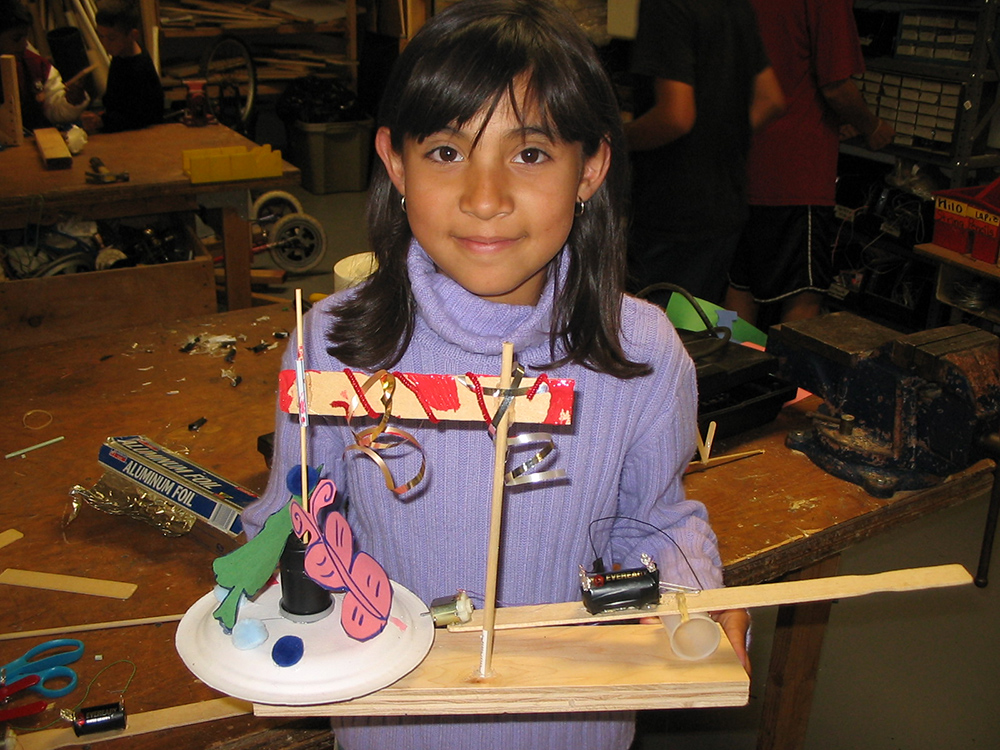
A CSW is a community space where kids and their families can go to create the projects of their imaginations and explore the physical and natural world. It is full of materials, tools, exhibits, specimens, and project models, many of these being composed of recycled scraps. CSWs exist in communities with high numbers of low-income, underserved families, and seek to offer these families access to hands-on learning through various programs. CSWs offer extraordinary opportunities, not often found elsewhere.
We have found that it isn’t easy to truly convey the idea of a CSW. Visiting is the best bet, but even after seeing a CSW program in person, the visitor will have caressed only one part of the elephant, and its full subtle complexity may still be hidden.
An easy way to get a rough idea of CSWs is to watch some videos. Check out our website here.
Another way to convey the essence of a CSW is by comparing it to other known entities. Here is a graphic of various common spaces that overlap with the mission and operation of a CSW:
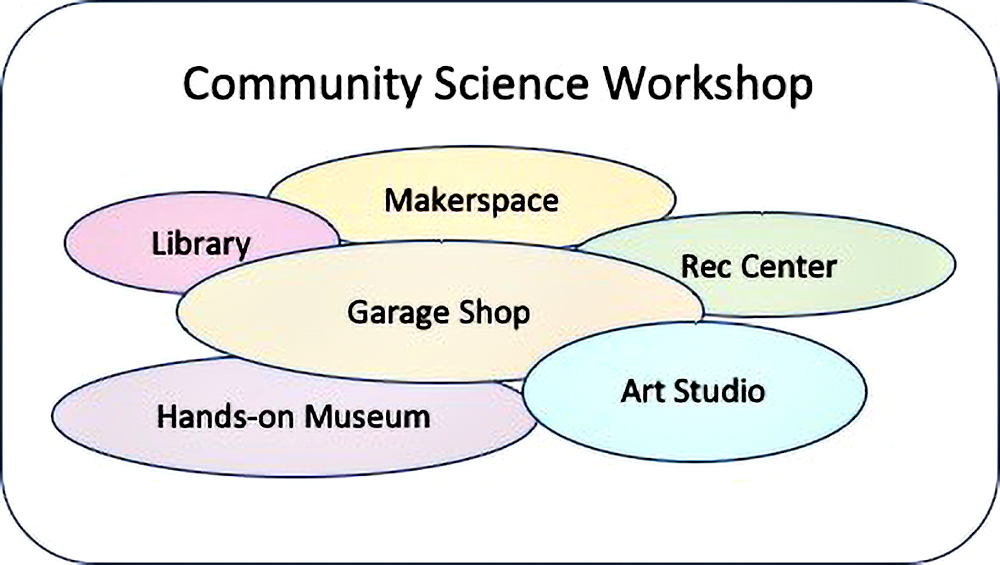
That’s a start, but it’s not complete. A CSW neither fully encompasses any of the spaces above, nor is limited to what they offer. For instance, many of us see CSWs as a public version of the personal garage workshop we had access to growing up. However, numerous integral components make it much more valuable: the ability to share ideas and feedback with other participants, a greater richness of project models and ideas, a greater variety of tools and materials, plus adult supervision that offers perhaps more than the parents or neighbors did in the garage shops of our youth. Museums have many of these elements, but in general lack areas where participants may freely tinker and build their own projects. Libraries and recreation centers, on the other hand, offer near complete freedom for participants to come and go, but offer activities in other content areas.
To adequately describe a CSW, we can approach it from several different perspectives:
A CSW is a space where community kids and their families can explore, use their imaginations, and create projects. It is full of tools, materials, specimens, exhibits, project models, and instruments related to science and engineering. There is ample space for tinkering and investigating in any realm imaginable. It is open regularly after school and on non-school days. Local kids and their families can easily reach the space and feel free and comfortable visiting whenever they’d like.
A CSW is a public space. Nearly every community has public spaces and values them. Research has found that it is incredibly valuable for kids to have a space where they feel a “rightful presence,” where they belong, and where everybody knows their name.
What spaces should every kid have access to? Our society has broadly agreed on a few: spaces to learn (schools), spaces for information access (libraries), spaces designed to facilitate physical activity (parks and recreation centers), and natural open spaces. We believe that spaces with tools, workbenches, and materials (workshops) should be on that list.
Many other activities are generally agreed to be good for kids and thus should be available for any and all who are interested: music, dance, theatre, artisan crafts, other cultural or historical traditions, etc. We rarely see building and exploring with tools and instruments of science on this list of activities, but we believe it should be.
Of course, some of these activities require designated spaces at different levels of complexity and specificity. We see that communities with sufficient resources offer such access through private spaces (personal garage shops, businesses, clubs) or through their institutions. In low-income communities, however, there is often not enough disposable income to support private workshops, and public institutions are often under-resourced and unable to provide them. Thus, creating a CSW that provides access to a welcoming, stimulating, “wonder-full” (in the words of CSW founder Dan Sudran), free space that also serves as a critical step towards equity, valuing low-income kids’ collective experience at the same level as their more affluent peers.
Could a middle- or well-resourced community have a CSW? Sure! What’s more, the lower-income communities that CSWs are part of may see their economic status rise. However, the Global Alliance of Community Science Workshops (GACSW) is currently focused exclusively on CSWs serving low-income families.
A CSW is a diverse community resource. Three areas in which communities currently use CSWs as resources include:
Families who want to tinker with tools and materials, build a shelf or doghouse, learn to solder or sew, or get a taste of different animals and plants can get it all from a CSW. Kids can get help with hands-on homework assignments or science fair projects. Families can try out tools before buying them for themselves.
Many schools can’t garner the resources they would need even if they wanted to offer the programming of a CSW. However, schools can leverage and partner with a CSW to provide various high-value educational resources:
Ideally, CSW staff have enough background knowledge in science to help families interested in learning more about local science issues. Several CSWs have done “citizen science” or “community science” projects with locally relevant issues, such as water quality or pesticides. This is a CSW at its best: giving access to specialized knowledge often out of reach of the communities they strive to serve.
A safe, inviting space—regardless of content—was already discussed above, but it bears repeating: such a space is a critical resource in the healthy development of humans, and thus communities (and thus democracy and a healthy planet!). Think back to your childhood. Chances are you had such a space, and the content or activity may not have been as important as the welcoming, trusting, we’ll-take-you-as-you-are atmosphere. There is no doubt that US kids in the 2020s face enormous challenges in the area of mental and emotional health. Any program that seeks to serve kids in any area has a responsibility to prioritize offering an environment conducive to that health.
Many current CSW staff have professed that the long-term relationships they have developed with students and families are one of the top perks of the job. Thus, the value goes both ways, as most CSW staff come from the communities they serve. Some of the original California CSWs have second and even third generations participating. A community that can maintain such a space for so long has offered an invaluable resource, and if some of those participants gained formative knowledge about the way nature or the physical world works, and perhaps some deep satisfaction and pride from that knowledge, all the better.
Justice and equal access is a final area in which CSWs can serve as resources. The CSWs serving kids in California’s Salinas Valley are a case in point. Simply offering kids a look into the world of science and STEM, the knowledge and skills required, and the possible career paths available is a transformative act. For decades, the immigrant families working in agriculture in this region were unable to access positions of power and wealth, in no small part because the technical knowledge was not available in educational institutions. Now there are more and more pathways towards well-paying, stable, high-tech careers in agriculture, and CSWs can help prepare and guide kids toward those careers.
Many of the “citizen” or community science projects that a CSW can take on are also based on environmental justice or equal access to health and nutrition. Many of the stories of injustice in low-income communities stem from families not having access to critical information while other entities make decisions that don’t consider the community’s welfare. Knowledge is power, and families with the right knowledge can gain the power they need to create the communities and environments they want, despite the powers that would seek to disenfranchise them for economic benefit.
CSW founder Dan Sudran worked in California with Cesar Chavez and the United Farm Workers labor union in the 1970s. He saw his work with CSWs as a continuation of this effort for justice and equality, and always referred to CSWs as a movement for justice. He would say, “Yes, it’s fun tinkering with junk together with kids, but don’t forget: in the process of doing that we’re changing the world.”
A CSW is a dynamic set of programs. Sometimes people will mistakenly refer to a CSW as a “STEM program.” This is again the situation of the person stroking but one segment of the elephant. As you can read in the CSE Programs section of this book, at least 14 types of programs are regularly run out of CSWs and nearly all CSWs have several different programs running at any given time. Some programs (like class visits or teacher training) are more commonplace and could be run without a CSW, while others (like mobile hands-on museums or the open-door, open-structure hours) are unique to the CSW model.
The different programs at a CSW build on each other, often in an efficient and mutually-supporting manner. For example, when a project is developed for use with a class, that project can easily be offered in the after-school program and amped up or modified according to a kid’s imagination. When there are leftover parts after a big project or event, no waste occurs because those parts can be easily incorporated into drop-in programs. The massive piles of materials generated for a science haunted house or a parade of contraptions are converted, with small effort, into base materials for other projects after the glory of the event is finished. And the construction refuse from a competition project like trebuchets or water rockets can easily be broken down and sorted into the materials bins for use at the drop-in program.
Even ideas flow seamlessly between the different programs. Often a kid’s “mistake” with a project at one program is recognized as a genuine improvement and immediately put to use in other programs. The low-stress and open timeline of the drop-in programs often results in more creative construction, and this goes back to benefit the programs such as class visits in which all kids are working on a single project under a timeline.
There are few limits on the programs a CSW can offer, as long as they are within the organization’s mission. Poetry or theater may seem like a stretch, but maybe not: much poetry has been penned onto wooden contraptions constructed at CSWs, and crafting props for a theater set is a natural use of a CSW. The sky is in no way the limit.
A CSW is also a community of practice. Academics Dr. Etienne Wenger and Dr. Jean Lave began focusing on communities of practice in the 1980s, together with other key elements such as situated learning and “legitimate peripheral participation” (learning naturally as a useful peon on the edges of some important operation). These academics have elaborated a complex theoretical basis around communities of practice, but agree that such communities have existed since human prehistory. Their nutshell definition for a community of practice is: “Groups of people who share a concern or a passion for something they do and learn how to do it better as they interact regularly.”
Participants in a community of practice develop a shared identity related to three commonalities: their domain of interest, their physical community, and their practice.
Communities of practice:
Psychology professor Dr. Barbara Rogoff has described an educational scheme she calls Intent Community Participation. She contrasts this with Assembly-Line Instruction, which she notes is often the norm in schools. With Intent Community Participation, the community of practice is engaged in “transformative participation in shared socio-cultural endeavors” toward their learning goals. Learners are fully incorporated and eager to contribute, belong, and fulfill their roles. Leadership is flexible; all may guide. This is laid out in some detail in the CSW book Make: Tinkering (2015).
All of this is happening in a CSW, somewhat obviously, and the point is that communities of practice are tremendously valuable to the participants as well as the broader community. If communities of practice have an intentional mission—as CSWs do—that mission is forwarded with particular effectiveness. Members of the CSW communities of practice reap the benefits of being surrounded by others keen to explore, create, and tinker with diverse tools and materials. They both learn and teach with their hands, and gain much knowledge from authentic personal experience, which they can put together with knowledge gained from teachers, books, and the internet. Whether it be dissecting a squid, deconstructing an old stereo, or building a go-cart, the point is that we are doing it as a caring, supportive group of people all interested in the outcome.
At CSWs, the community of practice is essentially the staff, active parents and volunteers, as well as the regular posse of kids who feel at home using tools, exploring specimens and devices, doing random experiments, and building things. CSW staff take every chance to encourage and solidify this community of practice, knowing its precious benefits, and everyone is welcome to join.
Claire at Pittsburgh CSW has thought long and hard about who she wants to serve and how, and creating a community of practice is at the core. She focuses less on quantity than on quality, and seeks out groups and individuals with the most need. For Claire, the top priority is offering kids the ongoing experience of bonding with facilitators who fan the flames of dreams and build confidence through competence, all in a CSW environment rich with ideas, life and phenomena.
Finally, it’s worth noting the boundaries of a CSW. This is not to overanalyze the situation, but rather to magnify the unique nature of CSWs. We see many STEM programs doing great stuff and offering ample hands-on education to students and communities. While CSWs overlap with and take part in some of these projects and programs, it is important to point out the distinctions as well.
Upon having a CSW described to them for the first time, many will nod and say, yes, a makerspace! Aside from the fact that CSWs were around for at least 10 years before the maker movement sprouted and flourished, there are several key distinctions between the two.
First, makerspaces are generally focused on higher tech projects such as digital fabrication and electronic interface. CSWs are primarily focused on lower tech projects with a broad base of topic areas, including biology, geology, art, and hand crafts. We are not in any way opposed to doing 3D printing or laser engraving, but in general it is a small part of our project repertoire, and almost never the entire focus of a program.
The main reason for this is that our projects are largely demand-driven, and despite the hopeful fervor of 20 years ago, we have generally found that few kids or adults come to us with ideas in need of digital fabrication. They do, however, come in with pressing project ideas in woodworking, metal working, needlework, technical art, animal care and rearing, and bicycle maintenance. These are all things that could happen at makerspaces, but generally don’t comprise the majority of makerspace activities.
Second, we have noticed that many times the instruments in makerspaces are complex to a level that students have trouble understanding the basic workings. These students often have little authentic experience with cutting, forming, or fastening different materials, but are now put in command of a machine doing these things. Students’ hands may have little contact with the materials being implemented, aside from inserting and retrieving them from the machines.
What’s more, at a makerspace ideas and designs must often be generated before any significant contact with the material in question, thus eliminating the absolutely critical phase of tinkering or mucking about. Photos representing makerspaces in operation are telling; they often display a group of clean students, hands behind their backs, standing around a machine of digital fabrication and observing it do all the work.
It is hard to learn much about plastic by watching a 3D printer. You learn the most when the printer screws up and you have to hack away a bunch of plastic that got ejected wrong, or when your design failed because it was too thick or thin or not built in sync with the properties of the plastic. By contrast, using hand tools puts you immediately at the mercy of your material’s properties, as well as the characteristics and limitations of the tools you are working with. You are forced to embrace the realities of the universe, so to speak, in real time. At the very least, having a preliminary low-tech, hand tool experience with a project or material gives one a great perspective with which to approach digital fabrication.
Finally, we have seen makerspaces promoted as an essential glimpse into today’s industrial reality: most of the physical things we consume and rely on are built with a good portion of digital fabrication. Thus, every student should have a chance to see what it’s all about. We don’t disagree at all with this view, and would only add that in light of this reality, it is even more important for every student to have an authentic experience with hand tools and basic materials of our modern lives: plastic, metal, wood, and cardboard, as well as ceramics, fabrics, stone, and glass. If it’s true that everyone will benefit from experiencing digital fabrication in action, it is all the more undeniable that everyone will benefit from having a working knowledge of drills, pliers, wrenches, and screwdrivers just in the course of keeping house and maintaining the functionality of the built world around us.
Our founder Dan Sudran used to make a distinction by noting that CSWs are “low tech, high science!” He often conveyed that the treasures and pleasures of discovering and appreciating the way things work—from a fish to an oscilloscope—are as important as any product or skills that may emerge from the participant’s efforts. He insisted that a CSW’s top priority is not STEM education. Rather, its priority is opening students’ eyes to the notion that parts of their world can be understood by exploring, observing, questioning, and tinkering, and that there is considerable pleasure and deep, soul-quenching satisfaction in the process of gaining this understanding.
It is worth noting a few other things that a CSW is not:
A CSW is Not an Afterschool Day Care.
Many families need afterschool day care, of the sort that takes responsibility for students and keeps them within the program. Few CSWs engage in this sort of programming. Parents are welcome to drop off students and tell them to stay in the Workshop, but in general CSW staff don’t keep track of students’ comings and goings during open drop-in sessions.
A CSW is Not a School or Structured Class.
CSWs rarely run classes with a set curriculum, a set of well-connected activities or projects with a methodical set of learning goals. Once in a while something grips a group of regular participants and staff, and everyone gets on board to learn the same thing so that one or more coherent class-like sessions takes place. Examples have been using Arduinos, welding, and etching sessions led by artisans from Mexico. But in general, CSWs support participants following models or how-to information from other sources, and of course individual or small group free tinkering.
Here’s a list of signals that something is wrong. That is, what’s going on is not necessarily CSW in nature, or needs to be bumped up a bit to attain full CSW value:
Session facilitators take only a small box or bag of materials into a school or other venue to carry out a CSW program.
Facilitators should bring a cart overloaded with materials, both scrap and new, as well as tools and decorations, power cords and cleanup supplies, and often a box full of exhiblets (phenomena on display), specimens, or live animals to interact with. There are a few exceptions of good projects that offer depth and creative options with few materials or very small materials, but in general a CSW is a stuff-intensive operation, wherein managing stuff and transporting stuff are serious, ongoing efforts.
Upon a group completing a given project, the results are seen to be nearly identical.
There should be a wild variety of outcomes reflecting the creativity of the kids and a diversity of materials and decoration options. We regularly expect entirely new ideas on how the project can be done. CSW staff commonly implore: “Teach me something you discovered!”
Extensive effort must be made to get the group of participants to listen and follow directions.
In general, kids at a CSW should be free. If they don’t want to listen and follow directions, they should be able to quietly, or not so quietly, follow their own path. There should be a clear distinction between a respectful maintaining of order on the one hand, and on the other the extensive, endemic coercion and control, threats, and rewards common in schools. Most long explanations and discussions at a CSW happen one-on-one or in small groups, not with the whole class of participants. The self-control necessary to participate in a collegiate group of learners is not necessary at a CSW; each is free to wander down the learning path of their own choice, or leave the path and head for the rocky hills.
Mostly staff voices are heard, staff questions are in focus, staff skills and ideas are on display.
Obviously, it should be the participants who are front and center for all activities, and staff should be constantly improving their most subtle and freeing techniques of godspeeding the participants on their own quests.
Kids are watching the clock, waiting at the door to go.
Ideally it’s the reverse: kids pounding on the door before opening time. You know things are going well when removing participants at the end of a session takes serious effort.
Sometimes it’s valuable to describe a CSW simply in terms of its benefits, or potential benefits, to the individual, family, school, and community. (It is difficult to separate these because a benefit to one is nearly always a benefit to all.) Following is a partial list.
We believe CSWs are unique and tremendously valuable. They stand out distinctly from other STEM education efforts and youth development organizations. At the risk of beating a dead horse, here are some borderline scenarios that attempt to make clear the nature of a CSW:
To be clear: each of these described above could be great outfits and do a lot of good! The Global Alliance of CSW may even be interested in striking up an friendship with them, but would stop short of inviting them to be a member site. In the cases not making the cut, other programs and activities are possible that would enrich the operation, and the GACSW would encourage and support this expansion.